
There are three kinds of lies: Lies, Damned Lies, and Statistics
-Mark Twain
People often ask how I can be so sure that passive investing is superior to active investing and my answer really comes down to basic arithmetic. I’ll be the first person to admit that there will always be active money managers who will outperform the market, whether due to luck or skill or a bit of both. But it’s a mathematical certainty that the average active money manager won’t outperform the market and in fact will underperform by the average amount of fees charged.
Let’s take a look at a simple illustration. Assume the entire stock market is made up of 5 companies and 3 active money managers. After each manager makes their stock picks, here is what the market might look like at the beginning of year 1 (note: a negative number means the manager is short the stock):

Now let’s roll forward one year and see what the performance might look like:
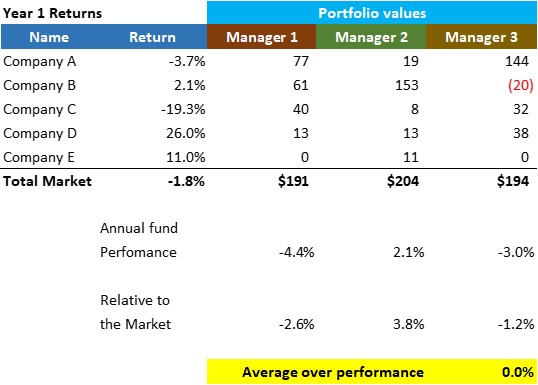
As you can see, manager 2 beat the market by 3.8% while managers 1 and 3 ended up underperforming by 2.6% and 1.2%. And the average performance of the active managers compared to the market was… zero (highlighted in yellow).
Now let’s look at year 2:
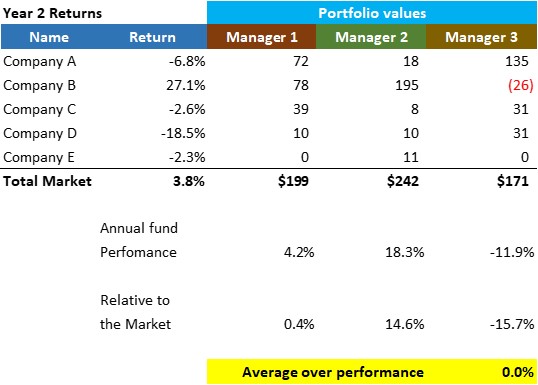
Manager 2 shot the lights out again thanks to a big position in Company B and beat the market by 14.6%. Manager 1 modestly beat the market by 0.4%, and poor manager 3 is getting fired for losing to the market by 15.7%. And again the average (or really the weighted-average) performance of the active managers compared to the market was… zero. We can run this example forward for many more years, but the arithmetic still holds and average relative performance will remain at zero.
What can this example tell us? First, the average performance of active managers (or really all investors) compared to the market will always be close to zero because those managers/investors in aggregate make up almost the entire market (or least the portion of the market that is not passively invested). And even though the pool of global managers and investors numbers in the billions, the arithmetic still holds. In any given year, some active investors will do better than the market and some will do worse, but their combined performance will match that of the market.
But what about fees?
So what are you really paying for with active investing? You’re essentially buying the possibility that your chosen manager will outsmart some other manager to essentially eat their lunch. According to the SPIVA scorecard, the odds of picking a manager who can outperform are not on your side. And given the poor odds, it’s likely prudent to keep a tight lid on total fees and use a low-cost, passive investment approach. There are some rare cases where it could make sense to pay up a bit more. For example, if you could identify the next Warren Buffett, then a higher fee could make sense. You may also consider paying a slightly higher fee for funds offered by companies like Dimensional or Avantis as some of their techniques could justify the extra cost.
And keep in mind that all of this likely applies to the average financial advisor too. If you work with a financial advisor who picks stocks, uses active investment funds, or charges the typical 1%-of-assets (or a combination of those), then it’s likely you could do better.
If you are interested in learning more about the arithmetic of passive investing, check out this article.
Thanks for reading!