
The action in Iran has dominated headlines over the past month, and for good reason. Unless your head has been buried in the sand, you’ve likely noticed the sharp rise in gas prices. Without a doubt, this event has introduced additional volatility into the financial markets. But how will this conflict affect your investments? As with most things its tough to say, but in large part I think it depends on how long the conflict lasts.
Up to this point the US and Israeli armed forces have relied on a large volume of airstrikes and likely some clandestine special forces operations to degrade Iran’s air defenses, eliminate Iranian political and military leadership, and generally just destroy any vulnerable military assets in Iran. Iran has responded by launching a variety of drones and ballistic missiles at both military and civilian targets as well as interrupting the flow of energy-related commodities through the Strait of Hormuz.
Israel and the US have had varying degrees of success protecting against Iranian attacks by using high-tech missile systems. But the US has yet to deploy any “boots on the ground” in significant numbers, although there are indications that the Pentagon is mobilizing some ground forces including a Marine Expeditionary Unit and parts of the 82nd Airborne Division. If I had to bet, I think that boots on the ground will be required to restore and maintain the flow of ships and fuel through the Strait of Hormuz, but of course I could be wrong. And of course, this is all complicated by the notion that a large deployment of US ground troops would likely be VERY unpopular from a political perspective.
So to my mind, I believe there are two likely outcomes.
- A resolution to hostilities within the next month or two.
- A prolonged engagement lasting another 6-12 months (or more).
If the Iranian mission is short-lived, then we’ll likely see many of the changes in the market reverse gradually. These would likely include a drop or stabilization in oil prices, a recovery in global stock prices, and reduced anxiety around future inflation. There has already been a significant amount of damage inflicted on energy infrastructure in multiple countries, but it’s possible that repairs could be executed and energy markets could adapt to adjust around any longer term repair work.
However, if both sides “take the gloves off” and start targeting energy infrastructure with more intensity, then a variety of ill effects are could come into play.
Higher inflation
First off would be the potential for elevated and persistent inflation in the mid-to-long-term. Hydrocarbons (i.e. oil, natural gas, etc.) still represent the lifeblood of our modern economies. So higher oil prices will boost a
As an example, the quickest way to estimate future long-term inflation is by comparing the yields on a standard treasury bond with the comparable treasury inflation-protected security (TIPS) bond. The current 10 year TIPS yield is about 2.1% and the current 10-year treasury yield is about 4.4%. This indicates a breakeven inflation rate of about 2.3%/year over the next 10 years. To me, this indicates that at least the treasury market isn’t too concerned about inflation. However, if oil prices reach $200+/bbl and stay there for a long time, then we could see a much higher realized inflation rate in the future.
Risk to reserve currency status
We could also see increasing risk around the US dollar’s status as the global reserve currency (albeit this would likely happen over a long period of time). Right now, the US dollar is widely used in global commerce, and the vast majority of all oil trading is priced in dollars. This provides a boost to prices of US treasury bonds as many countries use them to park their US dollar holdings. This helps keep US borrowing rates down and helps to finance US deficit spending.
However, based on this piece by Ray Dalio, a well regarded hedge fund investor, if the US cannot secure the free flow of goods through the Strait of Hormuz, or even if it takes the US a long time to do so, then the global economy could deem the US to have lost the conflict with Iran. Combined with unsustainable deficit spending of 5+% of GDP, you have a recipe for both human and financial capital looking for alternative homes outside the US.
For those who believe that the US military has all of this well in hand and will wrap things up soon, Dalio offers a good quote that I think is important to keep top of mind when analyzing any military conflict… “In war, one’s ability to withstand pain is even more important than one’s ability to inflict pain.”
Higher interest rates
All else equal, higher inflation would likely lead the Federal Reserve to raise short-term interest rates. If the international community begins to lose faith in the US dollar and sell off US treasuries, then we could see longer-term interest rates increase. We’ve already seen interest rates increase by about 0.4%, but that’s pretty negligible for the average investor. A longer engagement in Iran could drive rates much higher.
Possible recession and declining stock prices
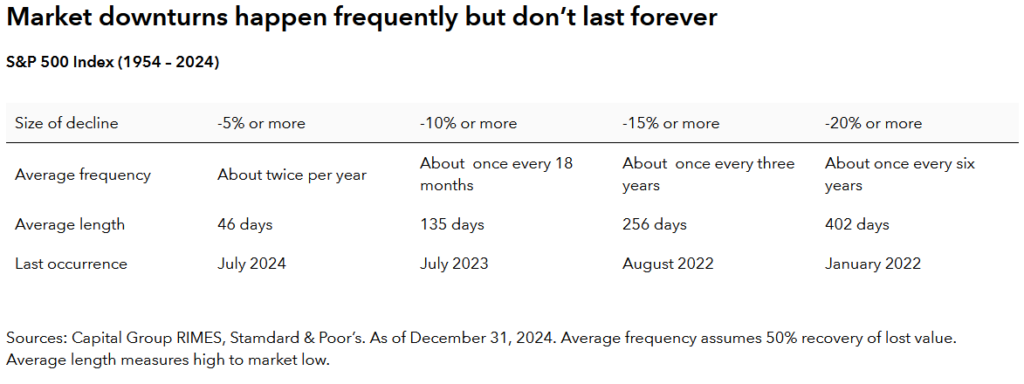
Higher inflation and interest rates would likely cause a drag on economic growth and could very well induce a recession in the US. And at current valuations, a recession could very likely lead to a re-pricing of US stocks. As I outline in my investment philosophy, I believe that all long-term investors should expect to endure a decline of 50+% in stock prices at various points in time. Do I think that will happen in this case? Not really, but anything is possible. Thankfully, large declines in stock prices only happen rarely (about 3 times in the last 50ish years), but they are a risk and Iran likely elevates the potential for large stock market moves. Smaller declines are more frequent, but as you can see in the following table, it’s not too hard to wait them out.
So what should I do?
The short answer is likely nothing. Unfortunately, investing ain’t easy. It’s risky and fear inducing, and can often be downright miserable. But loads of academic research has demonstrated that market timing is a tough game to win, so be wary of market prognosticators who advise selling all of your stocks and going to cash.
If you have a investing plan or strategy, staying the course is generally your best option. It never hurts to review your target asset allocation. And of course if something significant has changed in your financial situation, then take time to reevaluate your strategy. If you MUST do something, consider making a small change to see if that helps you feel a bit better. For those investors without a plan, it’s never too late to craft one!